If you’ve been told you need your ingrown toenail removed, you may have heard that there are different ways to do it. The short version: yes, there are, and the differences are worth understanding, especially if you’re trying to get back on your feet quickly or if this problem keeps coming back.
Foot Center of the RGV is the only podiatry practice in the Rio Grande Valley with the LightScalpel CO2 laser. Here’s what that means for patients, and how it compares to the traditional approach.
How Traditional Ingrown Toenail Removal Works
The standard procedure for removing an ingrown toenail has been around for decades, and it’s reliable. The toe is numbed with a local anesthetic, and the podiatrist removes the portion of nail that has grown into the skin, usually by cutting along the nail edge and pulling it free.
For recurring cases, a chemical called phenol is applied to the nail matrix (the root) along the removed edge, which prevents that portion of the nail from growing back. This is called a partial nail avulsion with matrixectomy, and it has a high success rate.
Recovery is generally straightforward, most patients are in a regular shoe within a few days. There’s some soreness for a few days after the procedure, and you’ll want to keep the area clean and dry while it heals.
Traditional removal is a proven, effective treatment. For the right patient, it’s still a perfectly good option.
How CO2 Laser Ingrown Toenail Removal Works
With the CO2 laser approach, the procedure starts the same way, with local anesthesia to numb the toe. From there, instead of cutting instruments, Dr. Quach uses the laser to remove the affected nail edge and, when needed, ablate the nail matrix to prevent regrowth.
The laser works by targeting water in the tissue cells, vaporizing them with precision that traditional cutting instruments can’t match. At the same time, it cauterizes as it goes, meaning it seals blood vessels and sterilizes the treatment area simultaneously.
The result is a procedure that is bloodless, significantly reduces infection risk, and tends to produce less post-procedure discomfort than traditional removal.
What’s Different Between the Two
Here’s a side-by-side of what matters to most patients:
Pain during recovery: Most patients report less soreness after CO2 laser removal than after traditional methods. The cauterization effect reduces inflammation in the surrounding tissue.
Infection risk: Traditional procedures create an open wound site that requires careful aftercare. The CO2 laser sterilizes as it works, which meaningfully lowers the chance of post-procedure infection.
Recurrence rates: For permanent solutions (removing the nail root), CO2 laser ablation of the matrix has lower recurrence rates than phenol matrixectomy, the standard chemical alternative.
Healing time: Patients treated with the CO2 laser generally return to normal activity faster. The tissue response is less intense, and the wound site heals cleaner.
Bleeding: Traditional procedures involve cutting, which means some bleeding is expected and managed. The CO2 laser is essentially bloodless.
Availability: CO2 laser ingrown toenail removal is not widely available. Foot Center of the RGV is currently the only podiatry office in the Valley currently offering it.
So Which One Should You Choose?
For most patients who come in asking about this, the CO2 laser is the better option, fewer complications, faster recovery, lower recurrence. That’s especially true if this is a recurring problem, if you’re on your feet a lot for work, or if you’ve had infection issues before.
That said, both procedures work well. Dr. Quach will evaluate your specific situation, which includes the severity of the ingrown nail, your history with the condition, and what matters most to you. Then he will recommend the approach that makes the most sense for you.
There’s no one-size-fits-all answer. What there is, is a conversation worth having before you decide.
What to Expect at Your Appointment
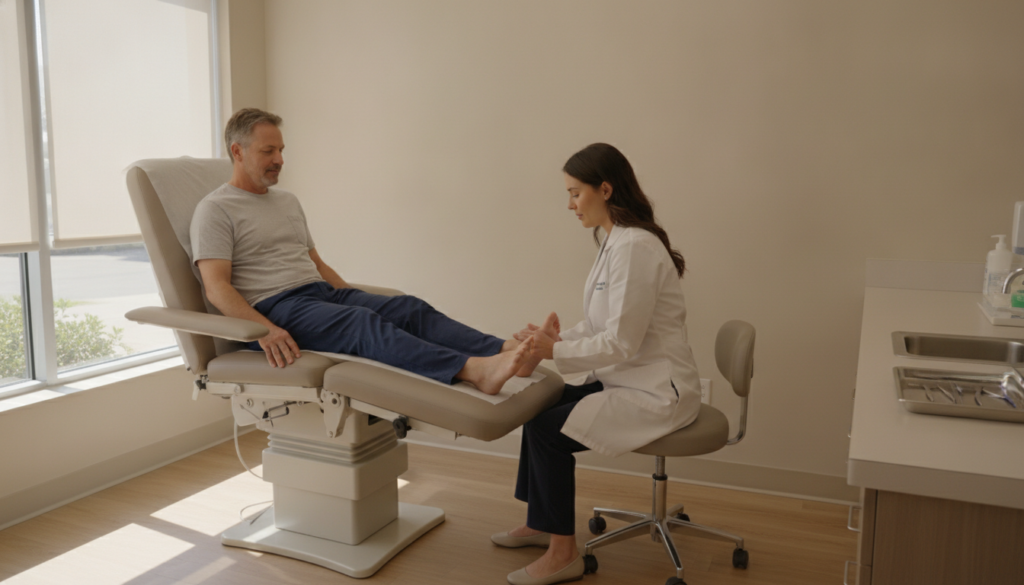
Whether you end up with CO2 laser or traditional removal, the visit looks similar from your end:
- You’ll come in, and the toe will be examined
- Dr. Quach will walk you through what he recommends and why
- The toe is numbed with a local anesthetic, the only truly uncomfortable moment
- The procedure takes 30–45 minutes, start to finish
- You leave in the same shoes you came in with (though soft footwear is more comfortable)
- A follow-up visit confirms everything is healing as expected
Most patients go back to work the same day or the next morning.
Foot Center of the RGV has offices in McAllen and Weslaco. If you’re dealing with an ingrown toenail — first time or recurring — Dr. Quach can walk you through your options. Call (956) 682-4187 or request an appointment online.