You wake up, swing your feet onto the floor, and the first few steps land like a nail through your heel. By mid-morning it has eased into a dull ache, easy to write off as tired feet from being on your feet too much. For a lot of adults in the Rio Grande Valley, that daily pattern has a name: plantar fasciitis, the single most common cause of heel pain in adults, according to the American Academy of Orthopaedic Surgeons (AAOS). Roughly 2 million Americans seek treatment for it every year, per an analysis published by the National Institutes of Health. This guide covers what is happening in your heel, who is most likely to develop it here in the Rio Grande Valley, what you can reasonably try at home, and when it is time to let a podiatrist take over, including the advanced option, radial shockwave therapy, that Foot Center of the RGV offers for cases that do not resolve on their own.
What Is Plantar Fasciitis, and Why Does It Hurt Most in the Morning?
Plantar fasciitis is inflammation and repeated micro-tearing of the plantar fascia, the thick band of tissue that runs along the bottom of your foot and connects your heel bone to your toes, according to the NIH’s clinical reference StatPearls. That band acts like a bowstring, absorbing shock every time your foot strikes the ground. When it is overloaded, it develops small tears and becomes inflamed, and the tissue tightens overnight while you sleep. That is why the pain is classically worse with your very first steps in the morning or after you have been sitting for a while, per AAOS patient guidance. As you move around and the tissue warms up and stretches, the sharp pain often fades into a duller ache, which is exactly the pattern that leads people to write it off as nothing.
Heel spurs, small calcium deposits on the underside of the heel bone, are frequently found alongside plantar fasciitis. AAOS publishes its plantar fasciitis guidance jointly with bone spur management for this reason, though the spur itself is often not the direct source of the pain. The inflamed fascia is usually the real culprit, which is one reason home remedies aimed only at “the spur” tend to fall short.
Who’s Most Likely to Develop It Here in the Rio Grande Valley?
Certain risk factors make plantar fasciitis meaningfully more likely, and several of them show up often in the patients Foot Center of the RGV sees across its Rio Grande Valley offices. A body mass index over 30 is an independent risk factor, according to a peer-reviewed systematic review indexed by the National Library of Medicine, and so is reduced ankle flexibility. Jobs that keep you on your feet for long stretches, whether that is retail, healthcare, food service, warehouse work, or a trade, are also associated with higher risk. Structural foot differences such as flat feet or high arches change how weight moves across the foot with every step and are a recognized contributing factor.
Plantar fasciitis is also more common in adults between the ages of 45 and 64 than in younger adults, and more common in women than in men, based on national health survey data. None of this means every RGV adult with one of these risk factors will develop plantar fasciitis, but it does explain why the condition shows up so consistently in a warm-weather region where people are on their feet outdoors, in sandals, and on hard tile and concrete floors much of the year.
What Can You Try at Home Before Seeing a Podiatrist?
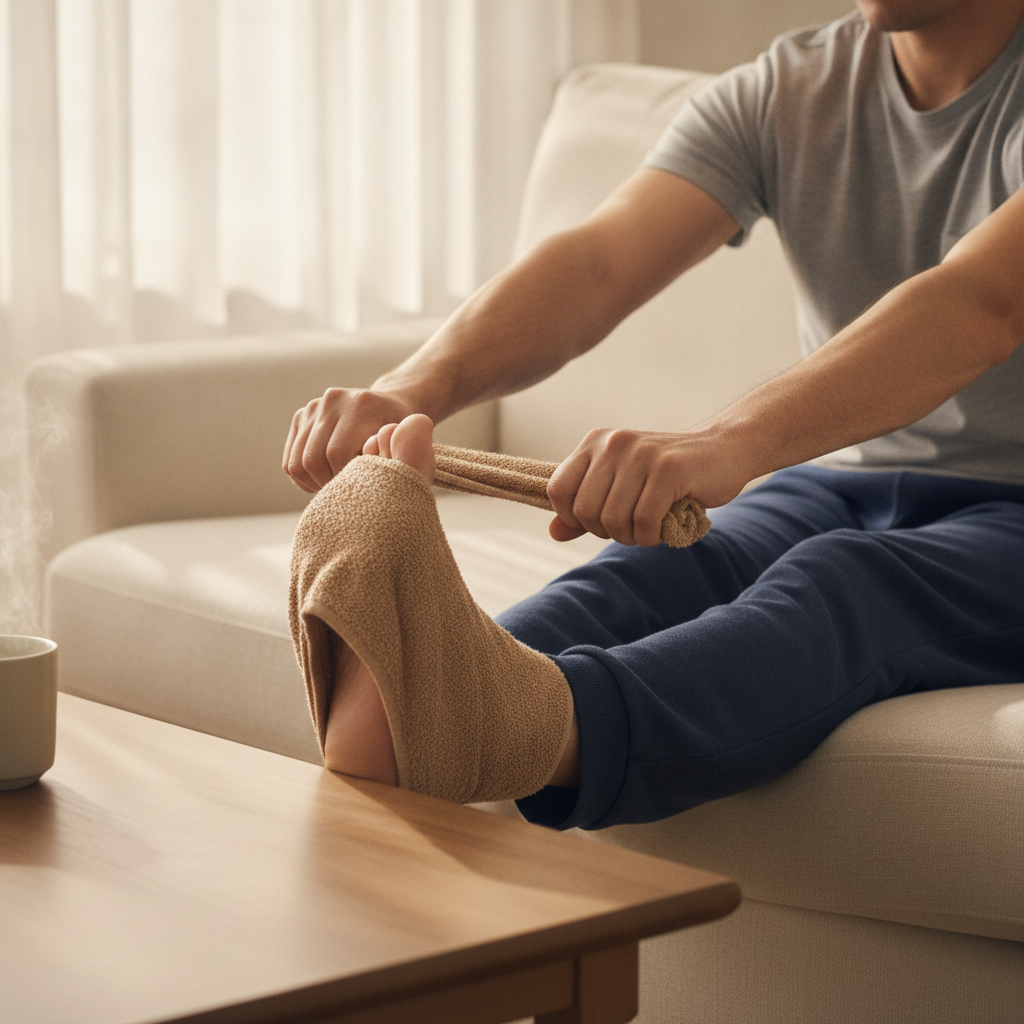
For a new, mild case, conservative self-care is a reasonable first step, and it works for most people. Stretching the calf muscles and the arch of the foot is considered the most effective way to relieve symptoms, per AAOS, because tight calf and Achilles tendon muscles pull directly on the plantar fascia with every step. A simple routine before you even get out of bed, gently stretching the arch and calf, can blunt that first-steps pain. Supportive, cushioned shoes with a firm heel counter matter more than most people expect, and walking barefoot or in flat sandals on tile floors tends to make symptoms worse rather than better.
Over-the-counter orthotic inserts are a standard first-line treatment and a low-risk place to start. Icing the heel after activity and resting from high-impact activity for a stretch can also help calm inflammation. AAOS notes that more than 90% of people with plantar fasciitis improve within 10 months of starting these kinds of simple, nonsurgical measures, and about 90% see significant improvement within 2 to 3 months. The catch is that those numbers assume consistent, correct treatment, not an inconsistent routine of stretching for a week and stopping once the sharpest pain fades.
When Does Heel Pain Need a Podiatrist Instead of Home Care?
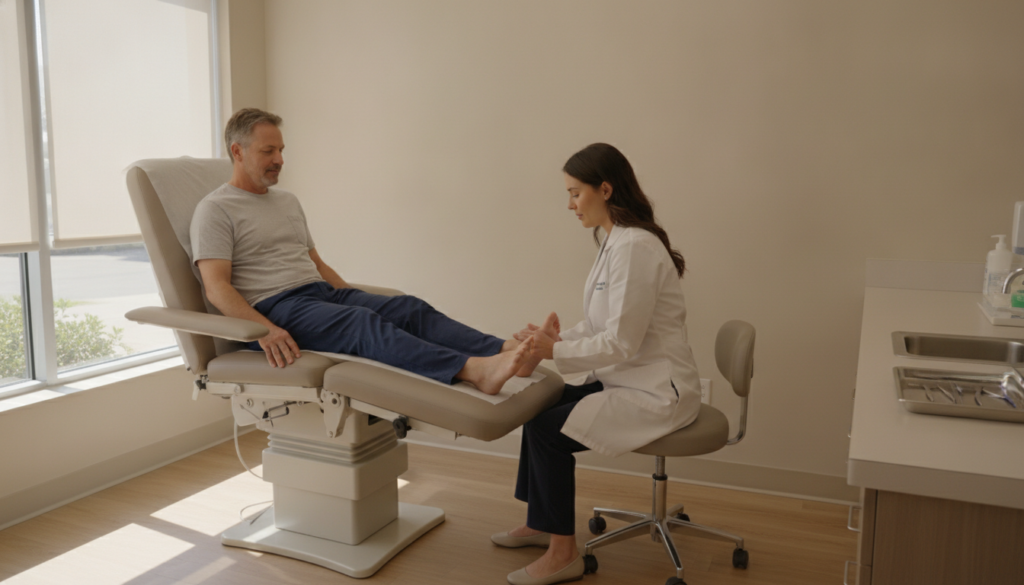
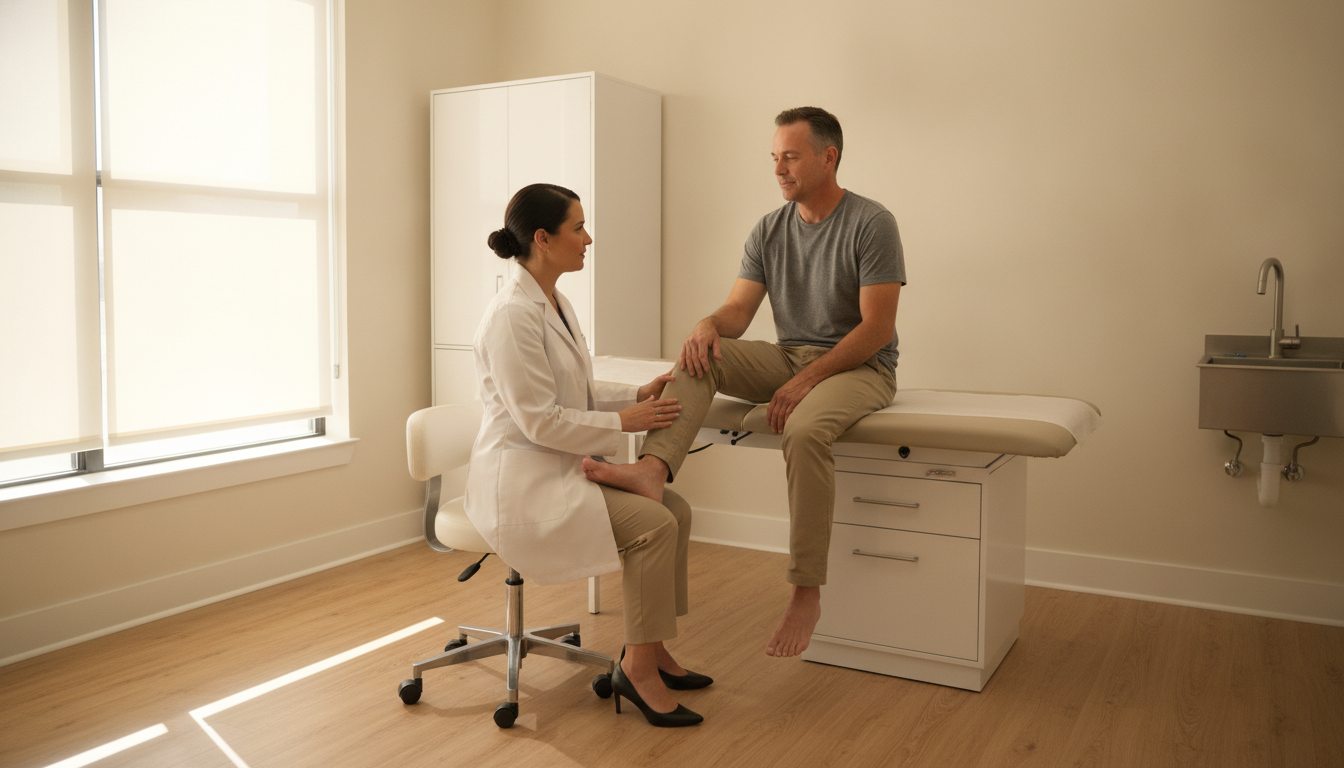
Heel pain needs a professional evaluation when it has not meaningfully improved after several weeks of consistent home care, when it is severe enough to change how you walk, or when it is affecting one foot noticeably more than the other with no clear cause. A podiatrist can confirm plantar fasciitis rather than a different source of foot or ankle pain, such as a stress fracture, nerve entrapment, or Achilles tendon problem, all of which can feel similar to the patient but call for different treatment. Foot Center of the RGV takes a conservative-first approach at both the McAllen and Weslaco offices: the goal is to resolve the problem with the least invasive treatment that works, saving more advanced options for the cases that genuinely need them.
A night splint, which holds the foot in a gently stretched position while you sleep, is a common next step for people whose pain is dominated by that first-steps-of-the-morning spike. Custom orthotics, built specifically for your foot rather than a generic insert, are also a standard escalation when over-the-counter versions have not been enough. These are the same categories of conservative treatment recommended by AAOS, and they are where most patients find lasting relief without ever needing a more advanced procedure.
What Happens When Conservative Treatment Isn’t Enough?
When months of stretching, orthotics, and activity changes have not resolved the pain, radial shockwave therapy is the next option Foot Center of the RGV offers, rather than jumping straight to surgery. Radial shockwave therapy, a form of extracorporeal shockwave therapy (ESWT), uses focused acoustic pressure waves delivered to the heel to stimulate the body’s own healing response in the damaged tissue. It is used specifically for plantar fasciitis that has not responded to months of conservative care, according to a meta-analysis of randomized controlled trials published through the National Library of Medicine, which found that medium-energy ESWT produced significantly better outcomes than a control group at 3, 6, and 12-month follow-up.
In one clinical study of radial ESWT, patients’ self-reported pain scores fell from an average above 7 out of 10 at the start of treatment to under 1 out of 10 by 12 weeks of follow-up. Results like that will not be identical for every patient, and Dr. Quach evaluates each case individually before recommending it, but the research base behind radial shockwave therapy is one of the reasons it has become a standard escalation step before surgery is even discussed, both nationally and at Foot Center of the RGV.
Recovery timeline with consistent conservative treatment
| Timeframe | Outcome (per AAOS and clinical research) |
| 2-3 months of consistent home care | About 90% see significant improvement |
| 10 months of consistent home care | More than 90% improve |
| Radial shockwave therapy, 12 weeks | One clinical study: average pain score fell from above 7/10 to under 1/10 |
How Foot Center of the RGV Treats Plantar Fasciitis
If your heel pain has outlasted a few weeks of stretching and better shoes, or it is bad enough that you are changing how you walk to avoid it, it is worth having it looked at rather than continuing to guess. Foot Center of the RGV evaluates heel pain at both the McAllen office, open Monday through Friday, and the Weslaco office, open Monday, Tuesday, and Thursday, so RGV patients have options close to home either way. Dr. Quach’s approach starts conservative, whether that is targeted stretching, custom orthotics, or a night splint, and moves to radial shockwave therapy for the cases that need more before surgery is ever on the table. If your mornings start with that first-step stab in your heel, schedule an evaluation at Foot Center of the RGV and find out what is going on before it becomes a habit you just live with.
FAQ
What causes plantar fasciitis?
Repeated micro-tearing and inflammation of the plantar fascia, the thick band of tissue connecting your heel bone to your toes. It’s typically overloaded by tight calf and Achilles tendon muscles pulling on it with every step, which is also why stretching those muscles is the most effective way to relieve symptoms.
What can plantar fasciitis be mistaken for?
A stress fracture, nerve entrapment, or an Achilles tendon problem can all feel similar to plantar fasciitis but call for different treatment. A podiatrist evaluation confirms which one you’re actually dealing with rather than guessing based on symptoms alone.
What’s the worst thing you can do for plantar fasciitis?
Walking barefoot or in flat sandals on hard tile floors tends to make symptoms worse rather than better, since it removes the cushioning and support that supportive, cushioned shoes with a firm heel counter provide.
How long does it take to recover from plantar fasciitis?
With consistent, correct treatment, about 90% of people see significant improvement within 2 to 3 months, and more than 90% improve within 10 months. Those numbers assume sticking with stretching and other conservative measures rather than stopping once the sharpest pain fades.