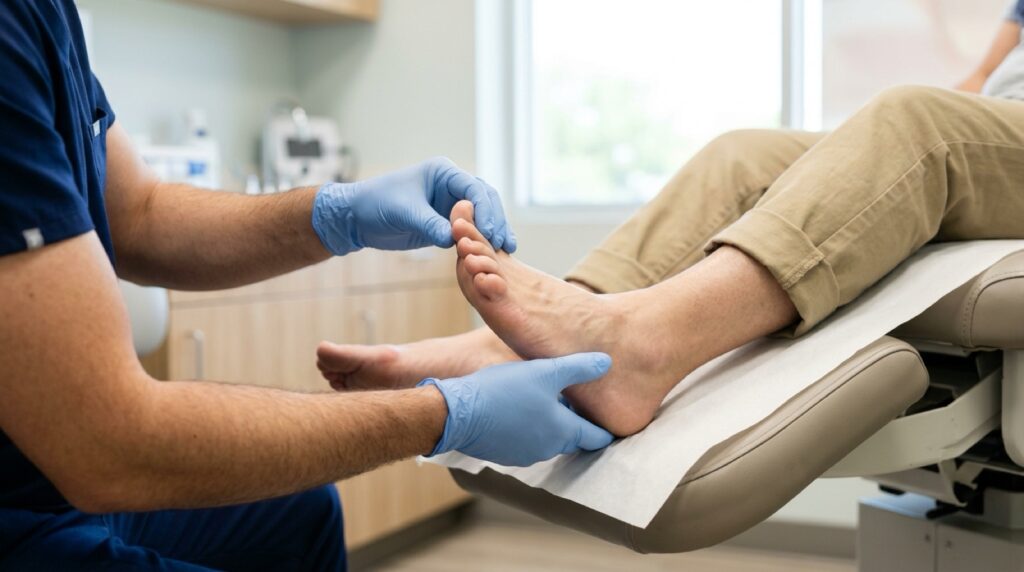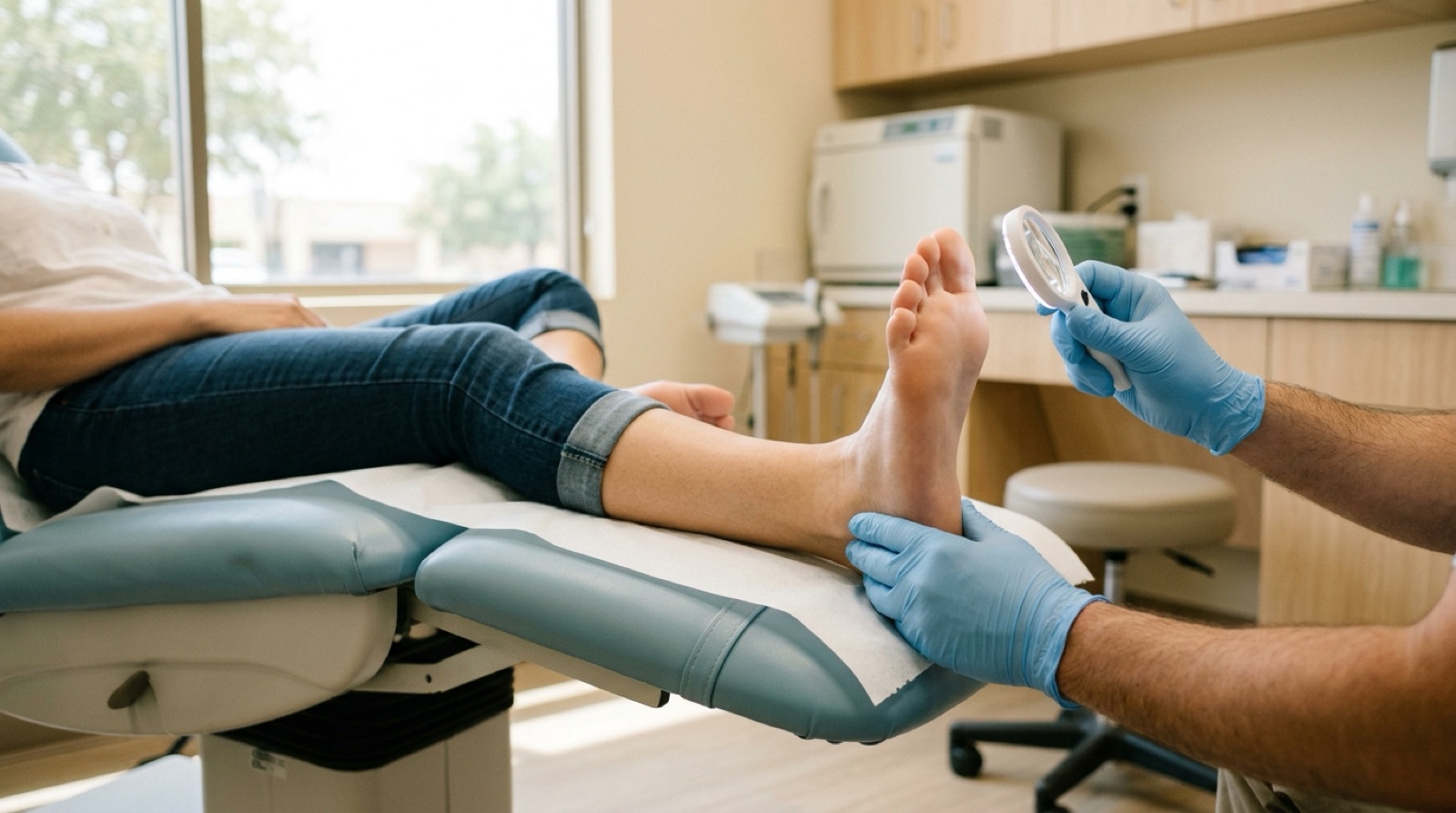
A corn is thickened skin caused by pressure, while a plantar wart is a skin growth caused by a virus, and on the bottom of your foot the two can look almost the same. The American Podiatric Medical Association (APMA) says plantar warts are often mistaken for corns or calluses, which is why the safest answer to “which one is it?” comes from an exam.
Foot Center of the RGV treats both at our McAllen and Weslaco offices, and telling them apart is the first step before any treatment. Here’s how corns and plantar warts differ, why guessing can backfire, and what a podiatrist does to know for sure.
What Is a Corn?
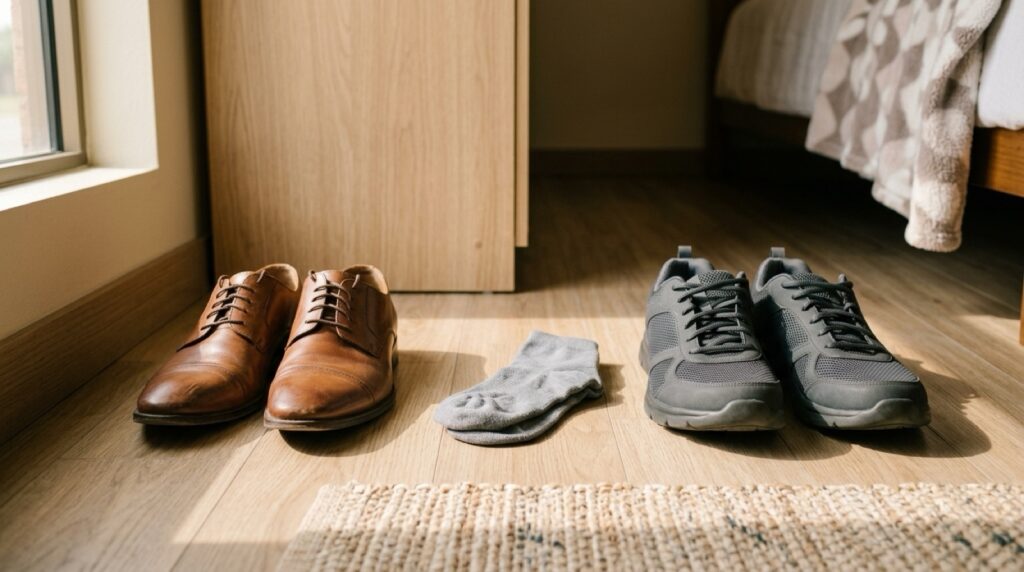
A corn is a small, dense patch of thickened skin that your body builds to protect itself from repeated pressure or rubbing, according to APMA. The American Academy of Dermatology (AAD) explains that corns form where bone presses against the skin, which is why they show up on the tops and sides of the toes and on the balls of the feet.
Cleveland Clinic describes three common types. Hard corns form on the tops of the toes, soft corns form between the toes, and seed corns are small corns that usually form on the bottom of the foot. That last group sits right where plantar warts like to grow, and our guide to dealing with seed corns on the foot covers them in more detail.
Corns usually have a mechanical cause. Cleveland Clinic lists poorly fitting shoes as the most common one, along with long hours of standing or walking, socks that bunch up, and foot shapes such as bunions and hammertoes that change where pressure lands. Corns are not contagious, and dermatologists note that most corns gradually go away once the pressure causing them stops.
What Is a Plantar Wart?

A plantar wart is a wart on the sole of the foot. Warts are caused by the human papillomavirus (HPV), according to AAD, and podiatry guidance from APMA adds that the virus gets into the skin through small or even invisible cuts. Because a plantar wart grows on a surface you walk on, each step presses it inward, and some people describe the feeling as walking on pebbles.
The virus behind plantar warts thrives in warm, moist places, and communal showers and bathing areas are common places to pick it up. That’s worth keeping in mind in the Rio Grande Valley, where McAllen averages about 177 days a year at or above 90°F, according to NOAA climate normals. If you use gym showers or other shared bathing areas during the Valley’s long hot season, those are the warm, damp places the podiatric association describes.
Plantar warts are contagious. A wart can spread to other people and to other parts of your own body until you can no longer see or feel it, according to dermatologists. APMA adds that untreated warts can grow to an inch or more and spread into clusters called mosaic warts, and that children, especially teenagers, are more susceptible than adults.
How Are Corns and Plantar Warts Different?
Corns and plantar warts differ most in their cause: pressure makes a corn, and a virus makes a wart. The rest of the differences follow from that, though several overlap enough that they can only be confirmed in person.
| Corn | Plantar wart | |
|---|---|---|
| Cause | Repeated pressure or friction, often from bone pressing on skin (AAD) | HPV (AAD) entering through small cuts in the skin (APMA) |
| Contagious? | No (APMA) | Yes, until it’s gone (AAD) |
| Typical location | Tops and sides of toes, balls of the feet; seed corns on the sole (AAD, Cleveland Clinic) | Sole of the foot, often on weight-bearing areas like the heel or ball (APMA) |
| Surface | Dense, hard skin; when pared by a clinician, a translucent core (Merck Manual) | Rough surface with well-defined borders, often gray or brown (APMA) |
| Black dots | None seen in a 2023 dermoscopy study (Cureus) | One or more black pinpoints, which are tiny clotted blood vessels (APMA, AAD) |
| Skin lines | Usually continue through the corn (Cureus 2023 study) | Interrupt the skin’s normal ridge pattern (Merck Manual) |
| Pain | Tender or sensitive to pressure (Cleveland Clinic) | Painful with direct pressure, and pressure on the sides can hurt just as much (APMA) |
| How it’s confirmed | Exam by a podiatrist | Exam by a podiatrist; a biopsy if anything looks unusual (MedlinePlus) |
Notice how much of that table depends on a closer look than most people can get at the bottom of their own foot. Thick skin can also build up over a wart, and a provider may need to trim it away first, per MedlinePlus, which means the telltale details are often hidden. The podiatric association puts it plainly: corns and calluses “can be hard to differentiate from warts.” Even pain doesn’t settle it, since both can hurt when you stand on them.
Why Is It Risky to Guess?
Guessing wrong can make a corn or a wart worse, and in rare cases it can delay care for something more serious. The two problems need different treatment, and many drugstore products for one can damage healthy skin around the other.
Here’s what the evidence says about the cost of a wrong guess:
- Acid products can injure healthy skin. “Some over-the-counter treatments contain harsh chemicals,” APMA warns about corn products, and those chemicals can lead to burns or even foot ulcers. The same podiatry guidance says over-the-counter wart preparations can destroy healthy tissue along with the wart.
- Cutting or digging creates new problems. MedlinePlus advises against removing a wart yourself by cutting, picking, or burning, and Cleveland Clinic’s advice is never to cut or shave a corn with a sharp object.
- Warts spread when they’re disturbed. Touching, scratching, or making a wart bleed can spread it, according to the podiatric association.
- Diabetes raises the stakes. People with diabetes or nerve problems in the feet are prone to ulcers and infections from corns and calluses, according to MedlinePlus. Cleveland Clinic advises people with diabetes or poor circulation not to treat corns or calluses themselves, and APMA says people with diabetes should especially avoid over-the-counter wart products. If you have diabetes, our post on diabetic foot care in McAllen explains why any new spot on your foot deserves a professional look.
- Some growths aren’t corns or warts. Although it’s rare, serious lesions such as carcinomas and melanomas can be mistaken for a wart, according to APMA, and a biopsy may be needed to confirm a growth is a wart and not another type of growth (MedlinePlus).
How Does a Podiatrist Tell Them Apart?
A podiatrist tells a corn from a plantar wart by examining it closely and, in many cases, gently paring away the thickened top layer of skin to see what’s underneath. When a podiatrist shaves away the thickened, dead skin of a corn or callus, the podiatric association notes, the procedure is painless because the skin is already dead.
What’s under that layer usually settles the question. According to the Merck Manual, a pared wart shows small black dots, which are clotted capillaries, and it tends to bleed, while a pared corn shows a firm, translucent core and does not bleed. Warts also break up the fine ridge pattern of the skin, the same kind of ridges that make a fingerprint, while those lines usually run straight through a corn.
A 2023 study published in Cureus put numbers on those clues. Clinicians examined 70 patients’ lesions under magnification, and every one of the 36 warts showed interrupted skin lines and black or red dots. Among the 14 corns, none had the dots, only 2 showed interrupted lines, and all 14 showed a translucent core once pared.
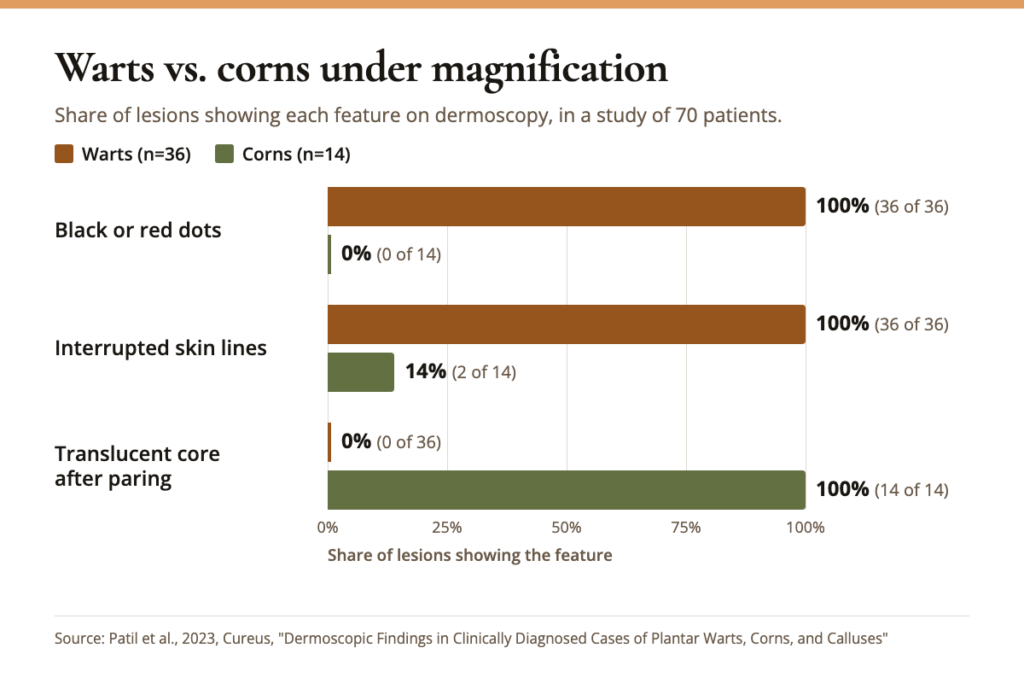
A podiatrist also looks beyond the spot itself. According to APMA, the exam may include checking your shoes, watching how you walk, and sometimes X-rays. That matters because, as Cleveland Clinic explains, a structural problem in the foot or toes can cause corns to keep coming back. If anything looks unusual, MedlinePlus notes that a biopsy can confirm what the growth is.
How Are Corns and Plantar Warts Treated at Foot Center of the RGV?
Corns and plantar warts are treated differently, which is the whole reason an accurate answer matters. Foot Center of the RGV takes a conservative-first approach to both, starting with the least invasive option that fits your foot.
For corns, the first job is removing the pressure. Shoe changes, padding, and in-office paring of the thickened skin are common podiatrist treatments, and Foot Center of the RGV also makes custom orthotics to change where weight lands on your foot. When a corn keeps returning because of a bone prominence or a toe deformity underneath, corn removal surgery addresses the corn and its structural cause after an evaluation and imaging.
For plantar warts, our plantar wart care starts with conservative treatments such as topical medications and cryotherapy. Most patients need more than one freezing session, repeated every 2 to 4 weeks, according to AAD. For warts that resist those treatments, Foot Center of the RGV offers CO2 laser wart removal, performed with the area numbed by local anesthesia, with a follow-up visit afterward. The podiatric association describes CO2 laser treatment as a common and effective option for warts.
If you already know you have a plantar wart and want to understand treatment and recovery in detail, our post on plantar wart removal for RGV patients walks through each step.
FAQ
Can a plantar wart look like a corn?
Yes. Plantar warts are often mistaken for corns or calluses, according to APMA. Thick skin can also form over a wart, which a provider may need to trim away (MedlinePlus). A podiatrist can usually tell the difference by examining the spot and paring away the top layer.
What happens if I put wart remover on a corn?
Wart removers contain acids or chemicals that destroy skin cells, and podiatry guidance warns that over-the-counter wart preparations can damage healthy tissue. Harsh over-the-counter chemicals used on corns can also lead to burns or even foot ulcers, according to APMA. They also won’t fix the pressure that caused the corn. If you have diabetes or poor circulation, don’t use these products without a podiatrist’s guidance.
Can I pick a corn out of my foot?
No. Cleveland Clinic advises never trying to cut out, shave away, or remove a corn with a sharp object. A podiatrist can pare a corn safely in the office.
Is it okay to dig out a plantar wart?
No. MedlinePlus advises against removing a wart yourself by cutting, picking, tearing, or burning it. Scratching a wart or making it bleed can also spread it, according to APMA. A podiatrist has several in-office options instead.
Do corns go away on their own?
Many do. Dermatologists say most corns gradually go away once the friction or pressure causing them stops, which is why changing shoes or padding is often the first step. A corn that keeps returning usually has a cause a podiatrist should check.
Still not sure what’s on the bottom of your foot? You don’t have to figure it out alone, and you shouldn’t treat it until you know. Foot Center of the RGV sees patients at our McAllen and Weslaco offices and offers conservative care for corns and warts, plus CO2 laser wart removal for the stubborn ones. Call our McAllen office at (956) 682-4187 or our Weslaco office at (956) 969-1063, or request an appointment online. It may look like a corn or a wart, but a podiatrist can tell for sure.