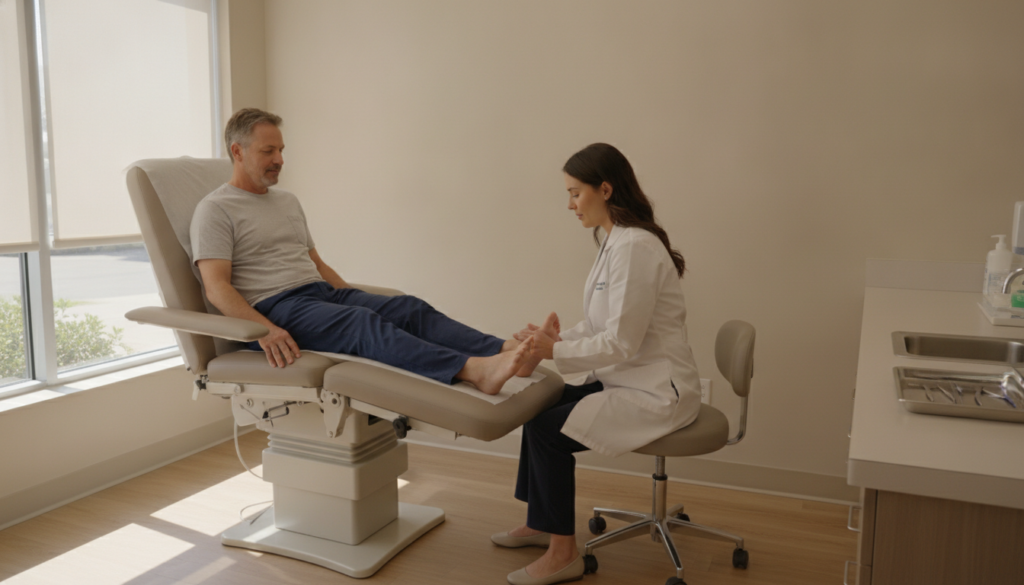
Skin tags on the feet are one of those things patients tend to live with for a long time before ever asking about removal. They’re not dangerous, so it’s easy to assume there’s nothing to be done about them beyond ignoring the irritation. However, when a skin tag sits in a spot where your shoe rubs against it every day, it’s simply a hard thing to ignore.
Here’s what skin tag removal involves, what recovery looks like, and how to tell whether it’s a quick in-office fix or a cosmetic add-on you’d be paying for out of pocket.
What Skin Tags Are, and Why They Show Up on the Feet
Skin tags are small, soft, benign growths that form wherever skin repeatedly rubs against skin or against fabric. On the feet, that usually means between the toes, around the ankle, or anywhere a shoe creates constant friction. They’re more common in people with diabetes, obesity, or hormonal changes. Genetics plays a role too, if skin tags run in your family, you’re more likely to develop them.
On their own, skin tags aren’t a health risk. The issue is almost always mechanical meaning that if you have a growth it can catch on socks, rub raw inside a shoe, or occasionally twist and become tender. None of that is an emergency, but it’s also not something that resolves on its own.
Cosmetic Concern or Medical Issue?
This is the question that determines how removal gets handled, and it comes down to whether the skin tag is causing you a problem or if it’s just sitting there.
A skin tag removed purely because you don’t like the look of it is a cosmetic procedure, and most insurance plans won’t cover it. A skin tag that’s catching on footwear, causing pain, becoming irritated or inflamed, or interfering with how you walk is a different story. When removal is addressing a functional problem, not just appearance, it’s typically treated as medically necessary and covered under most insurance plans.
Dr. Quach evaluates each skin tag individually. If it’s in a low-friction spot and not bothering you, there’s no urgency to remove it. If it’s somewhere your shoes hit it every single day, that’s usually enough to justify treatment on medical grounds.
What Skin Tag Removal Involves
Foot Center of the RGV is the only podiatry practice in the Rio Grande Valley offering CO2 laser skin tag removal, and for many patients, it’s the preferred option.
The visit is quick and typically done in a single office session:
- Dr. Quach examines the skin tag and confirms it’s a good candidate for laser removal
- The CO2 laser removes the growth with precision, sealing the treatment site as it works
- Because the laser cauterizes as it goes, bleeding is minimal
- Most small skin tags don’t require anesthesia, patients describe the sensation as a brief pinch or sting
For larger or more sensitive spots, other removal methods are available, but the CO2 laser is generally faster to heal and leaves less chance of the skin tag coming back in the same spot compared to traditional excision.

What to Expect in Recovery
Recovery from CO2 laser skin tag removal is about as straightforward as foot procedures get. Most patients see mild redness at the treatment site for a day or two, with no bandages or special aftercare required. You can walk normally and go back to your regular routine the same day.
The skin tag that’s removed won’t grow back. That said, if you’re someone who tends to develop skin tags, it’s possible new ones form elsewhere over time, but that’s more about your skin’s tendency toward them generally, not a sign that the removal didn’t work.
Is It Covered by Insurance?
In most cases, yes, as long as the skin tag is causing a functional problem rather than being removed for appearance alone. Coverage details vary by plan, and copays for laser treatment specifically versus other removal methods can differ. Our front office verifies your benefits before your visit so you know what to expect before you’re billed.
If a skin tag is purely a cosmetic concern for you, ask about self-pay pricing during your visit, it’s a quick, low-cost procedure either way.
Foot Center of the RGV serves patients in McAllen, Weslaco, and throughout the Rio Grande Valley. Dr. Quach offers CO2 laser removal for skin tags that are causing irritation, pain, or interfering with daily activity. Call us at (956) 682-4187 or request an appointment online.