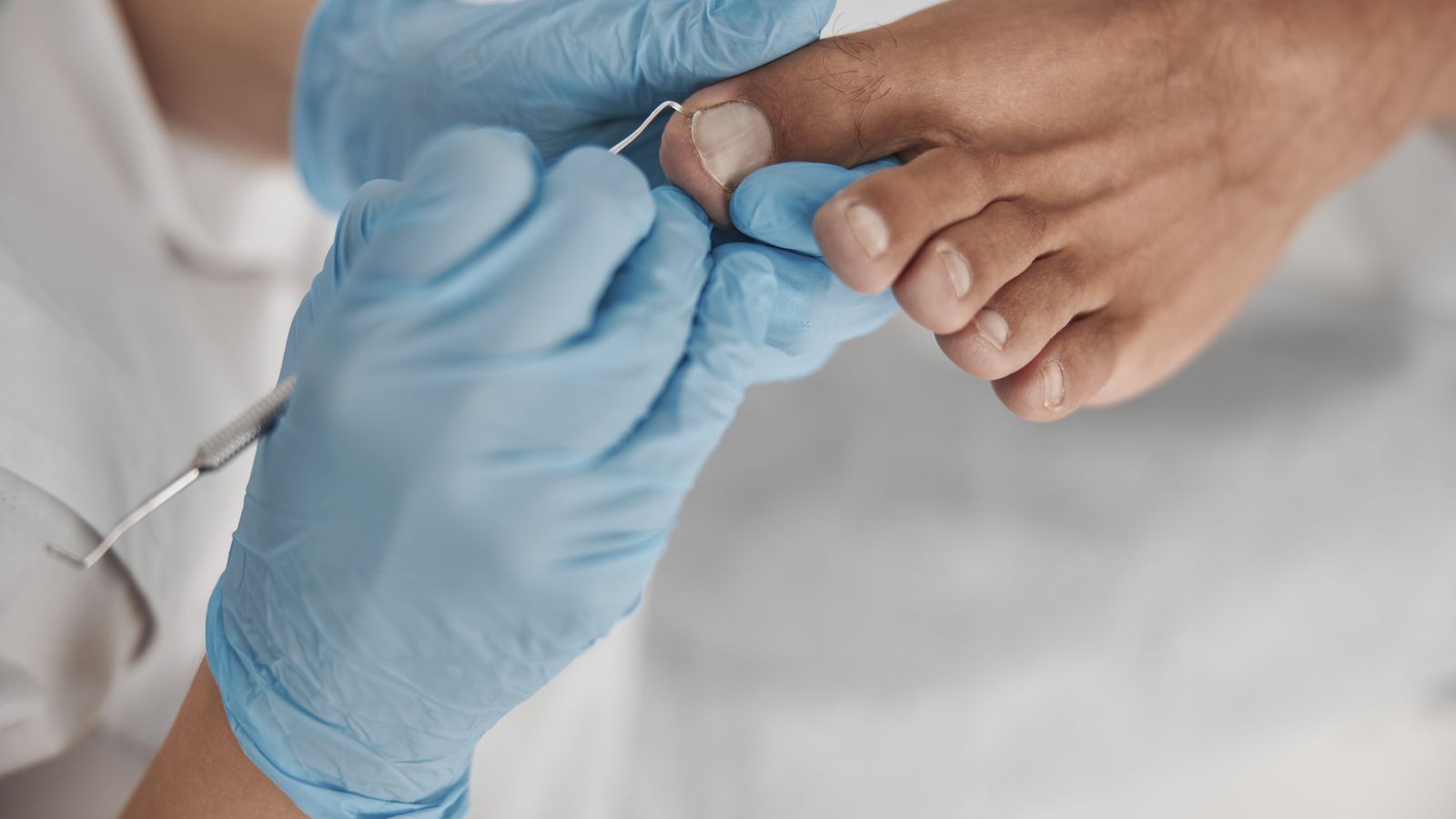
An ingrown toenail usually keeps coming back because whatever pushed the nail into the skin the first time is still there. The cause might be the way the nail is trimmed, the shoes on your feet, or the shape of the nail you were born with. The nail also keeps growing from the same root, so a fix that only removes the visible corner leaves the source in place. Foot Center of the RGV can look at why the same toe keeps flaring up and talk through longer-term treatment at its McAllen and Weslaco offices. Its McAllen office also offers the only CO2 laser nail procedure in the Valley.
You’re far from alone with this problem. A review in American Family Physician puts ingrown toenails at about 20% of the foot problems seen in primary care, most often in young men. The American Academy of Orthopaedic Surgeons (AAOS) adds that they are particularly common among teenagers and most often affect the big toe.
What Makes Ingrown Toenails Keep Coming Back?
You most likely keep getting ingrown toenails because of how the nail is trimmed and how your shoes fit. MedlinePlus, the National Library of Medicine’s health site, names those two as the most common causes. A nail trimmed too short, or rounded at the corners instead of cut straight across, may curl and grow into the skin. Picking or tearing at the corners can leave a jagged edge behind. Tight shoes press the skin against the side of the nail. For people who walk a lot or play sports, MedlinePlus notes, even a slightly tight shoe can be enough to cause the problem.
Other causes come from the nail itself. Some people are born with curved nails, and others have nails that are too large for their toes, according to MedlinePlus and AAOS. Stubbing a toe or having it stepped on can also start the problem. The American Family Physician review lists repetitive toe trauma from running and kicking among the risk factors.
Your age can play a part, too, according to an earlier American Family Physician review by Heidelbaugh and Lee. In teenagers, feet sweat more, which softens the skin and nails so they split into small spikes that can pierce the skin. In older adults, toenails thicken with age and become harder to cut. Reduced mobility or weaker eyesight can make trimming them properly even harder.
| Common reason | Why it can keep happening | Source |
|---|---|---|
| Trimming too short or rounding the corners | The nail edge can curl and grow into the skin | MedlinePlus, AAOS |
| Picking or tearing at the corners | Leaves a jagged edge that can dig in | MedlinePlus, APMA |
| Shoes that are too tight or too short | Pressure pushes the skin against the nail edge | MedlinePlus, AAOS |
| A nail shape you were born with | Curved nails, or nails too large for the toe | MedlinePlus, AAOS |
| Repeated toe trauma | Running, kicking, stubbing, or a toe stepped on | AAFP, AAOS |
| Thick nails or trouble reaching your feet | Proper trimming becomes harder | MedlinePlus, AAFP |
Table sources: patient guidance from AAOS OrthoInfo, MedlinePlus, and the American Podiatric Medical Association, plus clinical reviews in American Family Physician (2009 and 2019). The rows are reported risk factors with no rates attached.
Why Don’t At-Home Fixes Stop It From Coming Back?
At-home fixes rarely stop an ingrown toenail from coming back because they deal with the edge you can see. The nail keeps growing from its matrix, the root under the skin. AAOS describes the matrix as the part of the nail bed that grows the nail and holds it in place. A corner trimmed out at home grows back from that same root.
Cutting out the ingrown piece yourself can also make things worse. MedlinePlus warns against trying it. MedlinePlus also says over-the-counter products may ease the pain without treating the problem. The American Podiatric Medical Association (APMA) advises against do-it-yourself attempts to remove any part of an infected nail.
Hoping it clears up by itself is a gamble. The 2019 American Family Physician review notes that ingrown toenails are usually treated because they typically persist or get worse without proper care. MedlinePlus adds that the condition is likely to return without good foot care. For a first ingrown toenail, the Foot Center of the RGV post on when an ingrown toenail needs a doctor covers the warning signs in more detail.
When Should a Recurring Ingrown Toenail Be Seen by a Podiatrist?
A recurring ingrown toenail should be seen by a podiatrist when it keeps returning to the same nail edge. Go right away if there is drainage or excessive redness, or if you have diabetes, nerve damage in your feet, or poor circulation. APMA and MedlinePlus point to these signs:
- Drainage or excessive redness around the nail, which APMA says calls for a podiatrist immediately.
- Severe pain, swelling, or fever, which MedlinePlus lists as reasons to contact a provider.
- No improvement after a short trial of home care (APMA).
- The same edge keeps coming back. When an ingrown nail won’t heal or keeps returning, MedlinePlus says a provider may remove part of the nail.
- Diabetes, nerve damage in the feet, or poor circulation. MedlinePlus says to contact your provider right away and skip home treatment entirely.
An exam lets a podiatrist see the nail, the skin around it, and the pattern behind the flare-ups before recommending a longer-term fix.
Why Is a Recurring Ingrown Toenail Riskier With Diabetes?
A recurring ingrown toenail is riskier with diabetes because the condition may become serious in people with diabetes, poor circulation, or nerve problems, according to MedlinePlus. In severe cases, MedlinePlus notes, the infection can spread through the toe and into the bone. APMA says people with diabetes or circulatory disorders must avoid any form of self-treatment. They should seek care at the first signs of an ingrown nail.
Diabetes is common in Hidalgo County. CDC model-based estimates for 2023 put diagnosed diabetes at 17.4% of adults in Hidalgo County. MedlinePlus recommends routine foot exams and nail care for people with diabetes. Foot Center of the RGV offers diabetic foot care for patients across the Valley. The practice’s post on diabetic foot care in McAllen explains what to watch for between visits.
What Can a Podiatrist Do About an Ingrown Toenail That Keeps Coming Back?
A podiatrist can treat the root of the problem edge to lower the chance the ingrown nail returns. Treatment at the root aims to keep that strip of nail from growing back. APMA describes this treatment for ingrown nails that have become a chronic problem. According to APMA, the ingrown corner is removed along with the matrix of that piece of nail, using a chemical, a laser, or other methods. Doctors call this a matrixectomy.
Research supports treating the root, though it does not rule out a recurrence. A 2012 Cochrane review of 24 studies with 2,826 participants found surgical treatments more effective than nonsurgical ones at preventing an ingrown toenail from coming back. One trial in that review followed 117 participants. The ingrown nail returned in 41% of people treated with partial nail removal and matrix excision alone. When phenol, a chemical that destroys the nail root, was added, the nail returned in 14%.
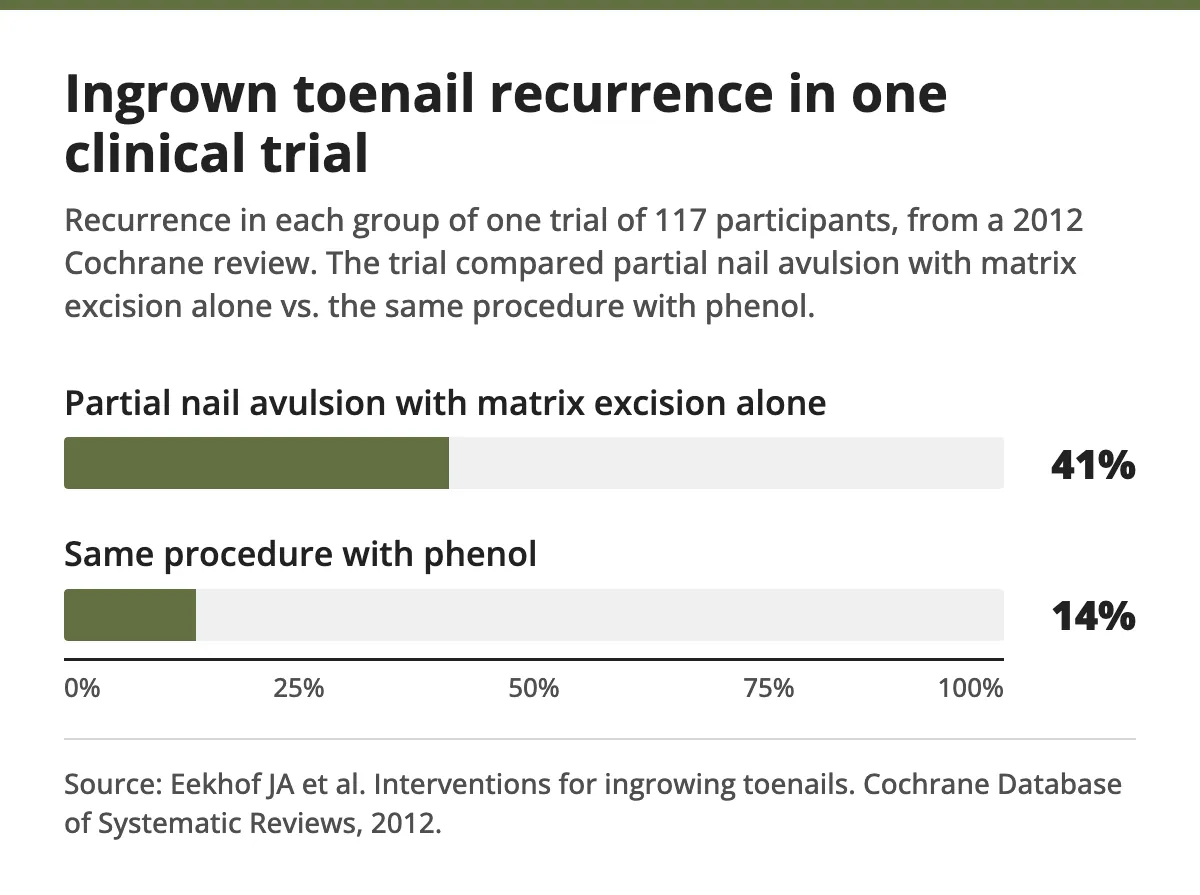
Recurrence in each group of one trial of 117 participants, from a 2012 Cochrane review. The trial compared partial nail avulsion with matrix excision alone vs. the same procedure with phenol. Source: Eekhof JA et al. Interventions for ingrowing toenails. Cochrane Database of Systematic Reviews, 2012.
The 2019 American Family Physician review notes that an incomplete matrixectomy can lead to a recurrence. The 2009 review by Heidelbaugh and Lee adds that a nail treated on one side can start growing in on the other side over time.
How Does CO2 Laser Treatment Help a Recurring Ingrown Toenail?
CO2 laser treatment is designed to remove the ingrown border and treat the nail matrix in the same procedure, with the toe numbed by local anesthesia. The 2009 American Family Physician review by Heidelbaugh and Lee lists three ways to destroy the matrix after the nail edge is removed: electrocautery, radiofrequency, and CO2 laser. The review calls all three effective options. According to the review, these methods share three advantages: less bleeding, less pain after the procedure, and immediate sterilization of infected tissue. The same review names the trade-off, too. Healing often takes longer, with local wound care for up to six weeks.
At Foot Center of the RGV, ingrown toenail removal starts with numbing the toe and removing the ingrown portion of the nail. When recurrence is a concern, a chemical or laser treatment is applied to the nail matrix with the aim of preventing regrowth in that area. The practice offers both traditional and CO2 laser approaches, and Dr. Quach can explain which one fits your nail.
Foot Center of the RGV is the only podiatry office in the Rio Grande Valley offering CO2 laser ingrown toenail removal. The laser is available at the McAllen office. The practice’s CO2 LightScalpel laser page explains the technology. A separate post comparing CO2 laser and traditional ingrown toenail removal walks through both procedures side by side.
How Can You Lower the Chance of Another Ingrown Toenail?
You can lower the chance of another ingrown toenail by trimming straight across and wearing shoes with room for your toes. AAOS and APMA both recommend these habits:
- Cut toenails straight across with a clean, sharp trimmer, without tapering or rounding the corners.
- Leave the nail no shorter than the edge of the toe.
- Never rip or tear the edges of a nail, and don’t dig into the corners.
- Choose shoes and socks with enough room for your toes, and skip pointy or narrow toe boxes.
- Protect your feet from injury, and keep them clean and dry.
Thick nails, limited reach, or diabetes can make trimming your own nails unsafe. For people who are prone to ingrown nails, Foot Center of the RGV notes that regular professional nail care can help.
FAQ
What should I do about ingrown toenails that keep coming back?
See a podiatrist about ingrown toenails that keep coming back, because treating the nail root can lower the chance the problem edge grows back in. APMA describes a procedure for chronic ingrown nails that removes the ingrown corner and its matrix with a chemical, a laser, or another method. Treatment at the root aims to prevent future ingrown nails on that edge, though studies show some nails still come back. Avoid cutting the corner out yourself, which MedlinePlus says will only make the problem worse.
Do ingrown toenails come back after removal?
Ingrown toenails can come back after removal, especially when the nail is removed and the root is left in place. A Cochrane review found surgical treatment more effective than nonsurgical care at preventing recurrence. The American Family Physician review notes that an incomplete matrixectomy can lead to a recurrence. A podiatrist can tell you which approach fits your nail.
Do ingrown toenails go away on their own?
Ingrown toenails often don’t go away on their own. The American Family Physician review says they typically persist or get worse without proper care. APMA advises seeing a podiatrist if a short trial of home care hasn’t helped.
Will my toenail look normal after treatment at the root?
Your toenail will usually look narrower after treatment at the root, because the procedure aims to stop the treated strip of nail from regrowing. The 2009 American Family Physician review says the treated area gradually settles into a somewhat normal appearance. The same review notes that the rest of the nail can shift over time and start growing in on the other side. Tell your podiatrist if the other edge of the nail starts to hurt.
Can I treat an ingrown toenail at home if I have diabetes?
No. People with diabetes, poor circulation, or nerve problems in the feet should not treat an ingrown toenail at home, according to MedlinePlus. APMA says they should seek podiatric care at the first signs. An ingrown nail can become serious in these patients, so call a podiatrist instead.
Tired of the same toe flaring up? Dr. Quach at Foot Center of the RGV can look at why your ingrown toenail keeps coming back and walk you through the options for treating it at the root. Learn more about CO2 laser ingrown toenail removal, offered at the practice’s McAllen office. Call the McAllen office at (956) 682-4187 or the Weslaco office at (956) 969-1063, or request an appointment online.